Most “just be yourself, just be consistent” advice skips the gatekeeper that decides whether anyone sees your video at all.
It’s weird how often we confuse effort with progress.
You finally get the green light to post more video. You carve out the time. You film it, cut it, share it. You’re proud of it.
And nothing happens.
Fourteen views. Three are from your mom. Two are you, refreshing. One is a stranger who tapped when they meant to swipe.
(If you’re at an association, swap “your mom” for “the board chair.” Same energy.)
So you double down on the advice everyone gives:
“Just be yourself.”
“Tell your story.”
“Consistency is everything.”
It’s comforting advice. And like most comforting things, it’s half true. Which also means it’s half false.
The gatekeeper nobody mentions
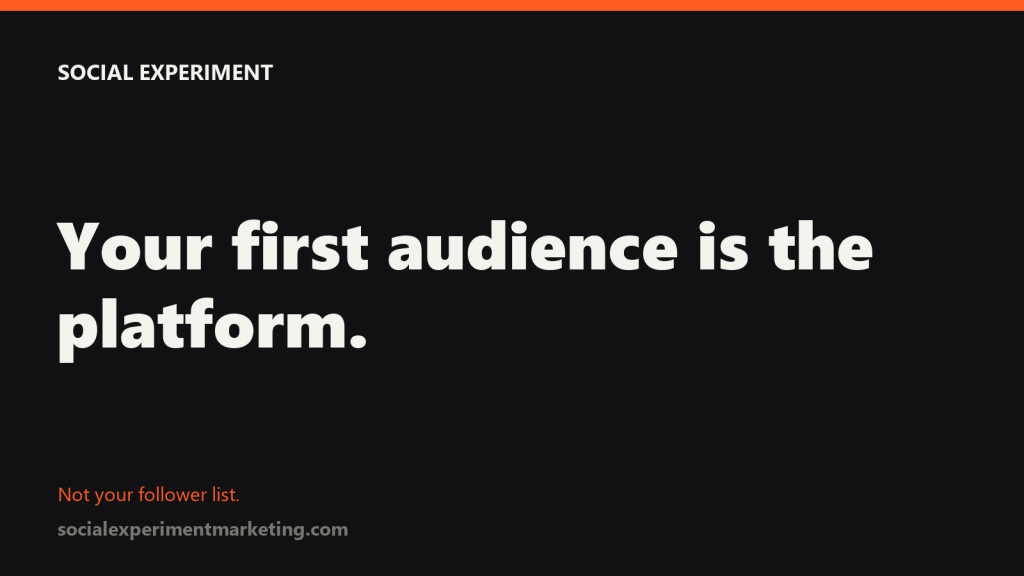
Here’s the uncomfortable part. You don’t serve your audience first.
You serve the platform.
Before your members, your congregation, your future hires or your ticket buyers ever see a video, it has to get past YouTube, Facebook, LinkedIn, Instagram or TikTok. They decide what gets seen and what fades away.
Think of the platform as the network exec deciding whether your weird little show makes it to air. If the exec doesn’t like the show, nobody sees it. It doesn’t matter how heartfelt, smart or sincere it is.
And what does the exec want? People staying on the platform, scrolling and watching, so it can sell more ads. That’s the whole business. So your video has to hold a stranger, not just please the people who already love you. And constant calls to action? You’re competing with their ads.
This isn’t selling out. It’s knowing the rules of the game you’re playing.
Five pieces of advice that are only half true
“Just post consistently.” Posting more does give you more surface area for luck. But if the content isn’t built for the platform, it’s just noise. A dentist posting “Happy Tooth Day” memes is technically active. Not effective.
Instead: post with purpose. Start with what the platform wants (short, engaging, native video) and work backward from there.
“Just be yourself.” People say this like it’s a strategy. It isn’t. Yes, people can sense when you’re not being genuine. But being genuine alone doesn’t make something interesting.
Instead: be yourself in service of connection. Look hard at the first five seconds. Why should a stranger care?
“If we stay consistent, it’ll pay off eventually.” Only if you’re improving. Gaining five followers a month isn’t a strategy. It’s a hobby.
Instead: iterate fast. Post five. Study the outlier. Double down. Learn from the ones that didn’t work too.
“Every organization needs to be on every platform.” The platforms want you to believe that, because your free content feeds their system. Not every channel is worth the energy, especially if you haven’t decided what it’s supposed to do for you.
Instead: know your why. If you’re not building toward something, burnout shows up fast.
“We’re creating for our audience.” Not first. You’re creating for the platform, and the platform decides whether your audience ever sees it.
Instead: think like a showrunner. Make the network happy. Then keep the viewers coming back.
What the network exec is looking for
- Portrait mode. It’s king.
- Clarity. People need to see faces and understand what’s being said.
- Watch time. Not too short, not too long. What matters is how much of the video people actually watch.
- Value. Something satisfying, relatable or informative.
- Honest labels. Accurate titles and descriptions, so the platform knows who to show it to.
Now the good news. The platform doesn’t care what your content is about. It needs every niche to keep billions of people scrolling. Steel castings, sermon clips, apprenticeship programs, Tuesday-night jazz. There’s room for all of it.
So stop overthinking the topic. Start working on how you present it.
A small challenge
Post five short videos this week.
Next week, check the numbers: views, likes, completion rate.
Then ask one question: why did one of them beat the others?
That’s your feedback loop. That’s the growth engine.
You’re not gaming the algorithm. You’re learning its language, so you can finally tell your story in a way that gets heard.
And maybe that’s what being yourself really means.
Not yelling louder. Just getting clearer.
If you’ve got a video library nobody watches, I’d like to see it.
 Social Experiment
Leave a comment